

AMH Test Normal Range by Age: What Your Result Means
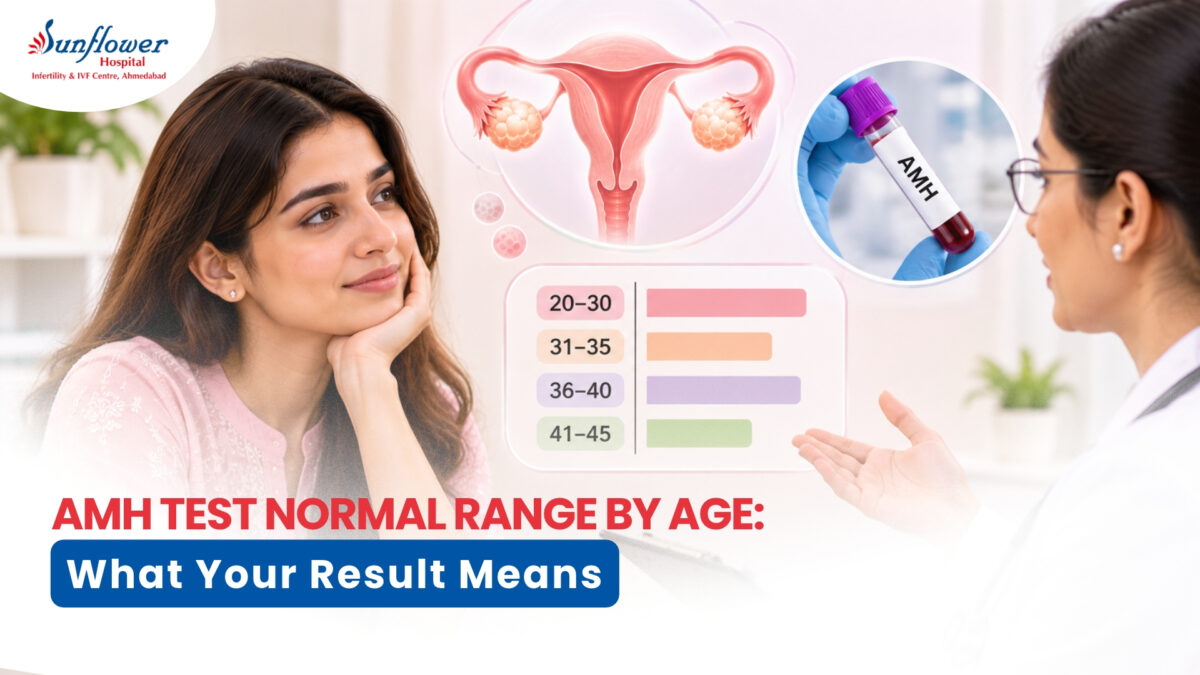

You get the report. A single number sits on the page next to the letters AMH. Maybe it is 0.8. Maybe it is 2.4. The report arrives with very little explanation, so you go home and type that number into Google. Suddenly you are reading forum posts from strangers that either terrify you or give you false comfort.
An AMH number means very little without context: your age, your other test results, and what you want to know. This guide explains what the test measures, what typical values look like at each age, and what to do with your result.
What does an AMH test measure?
AMH stands for Anti-Müllerian Hormone. It is made by the small follicles in your ovaries, the ones that hold immature eggs. A higher number usually means more follicles, and a lower number means fewer. In simple terms, it is a rough measure of your egg quantity, also called ovarian reserve. AMH and the antral follicle count on ultrasound are currently the simplest and most sensitive ways to measure it [2].
What it does not tell you is the quality of your eggs, and it cannot tell you whether you will get pregnant. In women aged 30 to 44 with no history of infertility who had just started trying to conceive, those with a low AMH (below 0.7 ng/mL) were about as likely to conceive within six cycles as those with a normal AMH (about 65 percent compared with 62 percent) [3]. A follow-up study found no link between low AMH and future infertility [4]. The ASRM, the main US fertility society, also says ovarian reserve tests are poor predictors of natural fertility in women whose fertility has not been tested [2].
These studies looked at women with no known fertility problem. They do not apply to women who already have PCOS, blocked tubes, or endometriosis, or who are struggling to conceive. AMH is most useful for predicting how you will respond to fertility medicines.
Good to know: AMH does not depend on the day of your cycle, so you can have the blood test on any day [2]. Fasting is usually not needed, but follow your lab’s instructions.
AMH normal range by age
AMH is highest in your early twenties and falls with age. That is not a sign of disease. It is how ovaries age.
The table below comes from one large 2025 study of 22,920 women aged 18 to 45, tested at a university hospital in Türkiye using a single type of AMH assay [1]. AMH is shown in ng/mL. The “typical range” is the middle half of women at that age, so about one in four women had a lower value and about one in four had a higher value.
| Age | Median AMH (ng/mL) | Typical range (ng/mL) | Women with AMH below 1.2 |
| 20 | 4.2 | 2.5 to 6.7 | 8.5% |
| 25 | 3.3 | 1.9 to 5.7 | 13.5% |
| 30 | 2.5 | 1.2 to 4.3 | 24.3% |
| 32 | 2.0 | 0.9 to 3.8 | 33.2% |
| 35 | 1.4 | 0.5 to 2.9 | 45.7% |
| 38 | 0.7 | 0.2 to 1.7 | 64% |
| 40 | 0.5 | 0.2 to 1.3 | 73% |
| 42 | 0.3 | 0.1 to 0.8 | 85% |
| 45 | 0.1 | 0.05 to 0.3 | 96% |
In this study, the median AMH fell below 1.2 ng/mL by age 36 [1]. A little over a third of the tests came from fertility or endometriosis clinics, but the pattern was almost the same when those women were left out [1].
How to use this table:
- A wide range at every age is normal. Two 35-year-olds with AMH of 0.6 and 2.8 are both inside the typical range, but they have very different amounts of reserve.
- The decline is gradual, with a faster fall from the mid-thirties.
- These numbers come from one hospital in one country. AMH values vary between populations and between lab tests, so your own lab’s reference range on your report is the one to use first.
A note on units: some labs report AMH in pmol/L instead of ng/mL. As a rough conversion, 1 ng/mL is about 7.14 pmol/L. Always compare your result with the range and units on your own report.
What does a low AMH mean?
A low AMH points to a smaller egg supply than is typical for your age. There is no single cut-off. A commonly used one for diminished ovarian reserve in IVF is below 1.2 ng/mL, from the POSEIDON classification, which is also the cut-off the 2025 study used [1]. Cut-offs differ between labs, so ask your doctor how your lab defines low.
Low AMH mostly predicts how you respond to fertility medicine. With fewer follicles, you may produce fewer eggs during stimulation [2]. It does not mean:
- That pregnancy is impossible
- That your eggs are automatically poor quality
- That your body cannot carry a pregnancy
If you have a low AMH and are trying to conceive naturally, the studies above found no clear drop in the chance of pregnancy over several months [3][4]. But age still matters a great deal, and those studies did not include women with known fertility problems. Low AMH is a reason not to wait, not a reason to panic.
What does a normal AMH mean?
A normal AMH for your age suggests that your egg supply is in the expected range. It is reassuring, but it does not guarantee fertility. Ovulation, egg quality, your tubes, your partner’s sperm, and your uterus all matter too. If you have been trying for some time without success, a normal AMH is not a reason to keep waiting. See our checklist of fertility tests for women by age.
What does a high AMH mean?
A high AMH means you have a larger number of small follicles. Many women with a high AMH are simply fertile with a good reserve. But AMH levels are on average two to three times higher in women with polycystic ovary syndrome (PCOS) [6]. There is no single cut-off for “high”. Some studies have suggested values from about 3.8 to 5 ng/mL or more, depending on the test used [7].
AMH alone does not diagnose PCOS. The 2023 international PCOS guideline says that, in adults, a diagnosis needs two of three features: irregular ovulation, signs of high male-type hormones (such as acne or excess hair, or a blood test), and polycystic-looking ovaries. A raised AMH can now be used in place of an ultrasound to show the third feature. Doctors should use one or the other, not both, and AMH is not recommended for this purpose in teenagers [5]. If your AMH is high and your cycles are irregular, read our guide to PCOS diagnosis and irregular periods and pregnancy.
With a high reserve, the response to stimulation can also be strong, so your doctor may adjust the IVF protocol to avoid overstimulation.
AMH result bands at a glance
| AMH (ng/mL) | General meaning | What to do |
| Below 1.2 | Low reserve by the POSEIDON cut-off [1]. Common after the mid-thirties. | See a specialist, especially if you are 35 or older and want a baby |
| About 1.2 to the upper end for your age | In the expected range for most ages [1] | Read it with your age and other tests |
| Well above the range for your age (some studies suggest about 3.8 to 5 or more) [7] | High. May go with PCOS. | Ask about PCOS and cycle regularity |
These are general guides. Cut-offs vary by lab and test, so use the reference range on your own report.
What can lower AMH?
Age is the main factor, but other things can reduce AMH:
- Endometriosis. In the 2025 study, women treated in an endometriosis unit had lower AMH than women from other clinics (median 1.6 against 2.0 ng/mL) [1].
- Ovarian surgery, such as removal of a cyst [6]
- Chemotherapy or pelvic radiation
- Long-term use of hormonal contraception. A review of 15 studies found that AMH stayed the same in women who used the pill for up to six months, but it fell clearly in long-term users and recovered after they stopped [8].
If you are on hormonal contraception, tell your doctor before the test.
Which other tests go with AMH?
AMH works best alongside other tests:
- Antral follicle count (AFC): an early-cycle pelvic ultrasound that counts the small follicles in your ovaries. Read about sonography for infertility assessment.
- FSH and estradiol: blood tests done early in your cycle.
- Thyroid, prolactin, and semen analysis: to look at other possible causes. See our page on male infertility.
- A tube check, if you have been trying for a while. Read about blocked tubes and whether they can be opened naturally.
Together these give a fuller picture of your female fertility.
What are your next steps if AMH is low?
Your egg supply does not rebuild, so time matters more if your AMH is low. Depending on your age and goals, your doctor may suggest:
- Trying naturally, or with IUI, for a short period if you are younger and have no other problems
- IVF sooner rather than later, sometimes with a stimulation protocol adjusted for a low response. Success depends mostly on age, so see our guide to IVF success rate by age, and our IVF cost guide
- Egg freezing if you are not ready for pregnancy yet
- Egg donation if your own eggs are unlikely to work
As a general guide, if you are 35 or older and your AMH is low, see a fertility specialist early instead of waiting a full year.
The bottom line
Your AMH is a useful number. It helps your doctor plan, and it helps you understand your ovarian reserve. But it is not a crystal ball. It does not show your egg quality or predict your future.
If your result is lower than you hoped, do not panic. Ask better questions. What does this mean for my age? What does my antral follicle count show? What are my options: natural conception, IUI, IVF, or something else? The number is the start of a conversation, not the end of one.
Frequently asked questions
Is an AMH of 1.0 low?
It depends on your age. In the 2025 study, the median AMH was 1.0 at age 37, 2.0 at age 32, and 2.8 at age 28 [1]. So 1.0 is about average at 37, but well below average at 28. It is also below the common 1.2 cut-off for low reserve. Discuss it with your doctor.
Can I get pregnant with an AMH of 0.5?
Yes, it is possible, both naturally and with treatment. In women with no known fertility problem, a low AMH did not clearly lower the chance of conceiving naturally over several months [3]. But the number of eggs retrieved in IVF is usually lower, so it is worth seeing a specialist early.
Can AMH go up?
It can rise a little in some situations, for example after stopping long-term hormonal contraception [8], and it varies a little between tests. But your egg supply falls with age and does not rebuild [2]. Be careful with any product or treatment that claims to raise AMH, and ask your doctor first.
Do I need to fast or time the AMH test?
No timing is needed. You can have it on any day of your cycle [2]. Fasting is usually not needed, but follow your lab’s instructions.
Is AMH the same as fertility?
No. AMH reflects egg quantity, not quality, and it cannot predict pregnancy on its own [2][3].
Can I have a high AMH and still struggle to conceive?
Yes. A high AMH can go with PCOS and irregular ovulation. Other factors such as tubes, sperm, and the uterus also matter.
Should every woman get an AMH test?
No. It is most useful if you are planning IVF or egg freezing, have irregular cycles, have had ovarian surgery, or have endometriosis. It is not a reliable way to check how fertile you are if you have no fertility problem [2][3]. Ask your doctor whether it makes sense for you.
Why choose Sunflower Hospital?
A number on a report is easier to face with the right team beside you. Here is what you can expect at Sunflower:
- Over two decades of experience: helping families since 2004 under Dr. R G Patel, a National ART & Surrogacy Board member.
- A proven track record: more than 1,500 IVF and ICSI procedures a year and over 22,000 live births.
- Complete care under one roof: fertility testing, sonography, IUI, IVF, ICSI, egg freezing, and donor programmes.
- Personal guidance from day one: send your reports, including your AMH result, by email or WhatsApp and our doctors will give you an expert opinion before you visit.
- Convenient locations: Memnagar, Naroda, Gandhinagar, Surat, and Naranpura.
If you have received an AMH result and want to understand what it means for your fertility, the specialists at Sunflower Hospital can interpret your numbers in the context of your age, your history, and your goals. Book a consultation and get clarity instead of confusion.
related blog
AMH Test Normal Range by Age: What Your Result Means

IVF Success Rate by Age: What the Numbers Mean at 35, 38 and 42