Book Appointment

IUI Treatment in Ahmedabad

Intrauterine insemination (IUI) is among the simplest treatment procedures available for couples undergoing fertility treatment. The sperm sample used is processed through advanced technology and is introduced into the uterus at the right time relative to the ovulation cycle of the woman. By utilizing this method, the sperm has a relatively short route to reach the fallopian tubes in the woman’s body. It's a low-intervention, comparatively affordable IUI treatment for pregnancy, and for a good number of couples, it's a sensible place to start.

IUI Treatment

What Is IUI Treatment?

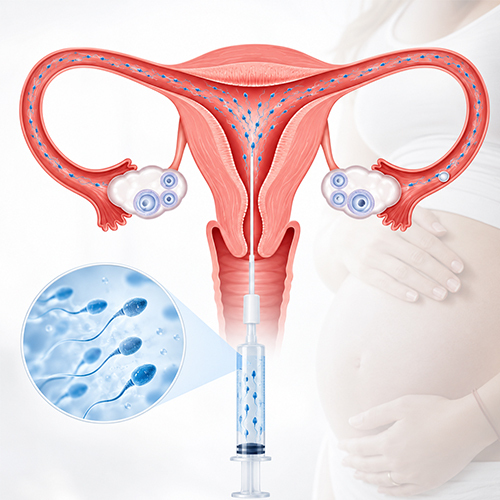
Intrauterine insemination (IUI) is a form of fertility therapy whereby the semen is first processed in the laboratory, and the healthiest motile sperm from the male reproductive fluid along with other diverse cells is segregated from the sample during this process. Once successfully processed, the sample is introduced into the uterus above the internal os through a thin-tubed catheter. As an intrauterine insemination treatment, the idea is simple: get more sperm reaching the fallopian tubes right when an egg is ready to be fertilised.

Who May Benefit From IUI

A few situations tend to bring people toward IUI. It's often suggested when intercourse itself is difficult, whether for a physical or psychological reason, when a couple is using donor sperm, or when male infertility is involved. It also comes up for other causes, like a cervical infection or mild endometriosis in the female partner.

More broadly, intrauterine insemination is most commonly used for unexplained infertility, and for couples dealing with mild endometriosis, ovulation problems, mild male factor infertility, or cervical factor infertility. As an IUI treatment, it's usually tried for around three to four cycles in women who are ovulating on their own. For women with polycystic ovaries who aren't ovulating and are on medication to induce it, continuing IUI a bit longer than that is reasonable.

IUI for Male Factor Infertility

IUI can genuinely help with some cases of male factor infertility, but sperm quality sets a real ceiling on how well it's likely to work. When a processed sperm sample yields a motile sperm count that is less than 5 million, the chance of conception decreases significantly. The chances of success become low in the range of 1 million to 5 million motile sperm per ml, and in such cases, the recommended mode of treatment is to go for IVF with ICSI.

This is why a male fertility test procedure, essentially a semen analysis, matters early on. By understanding the motile sperm count prior to initiating treatment, your doctor can steer you towards the effective option instead of wasting months on an ineffective one.

Indications and Contraindications

When IUI Is Recommended

On the female side, IUI is generally considered for cervical factor infertility, ovarian dysfunction, and endometriosis. On the male side, it applies to abnormal semen parameters and ejaculatory dysfunction. It's also used for unexplained infertility, for HIV serodiscordant couples, and for donor insemination.

When IUI Isn't the Right Choice

IUI isn't suitable for everyone. It's generally not recommended if both fallopian tubes are blocked, if semen quality is very severely affected, if there's a genital tract infection, or if pregnancy itself would be medically contraindicated for the female partner.

How Ultrasound Guides an IUI Cycle

Ultrasound monitoring is what actually times an IUI cycle correctly. Transvaginal ultrasound tracking usually starts on day 7 after beginning an ovulation induction medication, or day 9 in a natural cycle, and continues until the follicle is ready.

The ovulation trigger injection goes in once the leading follicle reaches maturity, generally around 18 mm or more in mean diameter. Before that, your specialist is watching for signs that ovulation is close: a dominant follicle of roughly 16 to 18 mm, blood flow wrapping around three-quarters of the follicle's circumference (with a peak systolic velocity above 10 cm/sec), an anechoic area or double contour forming around the follicle (usually meaning ovulation within 24 hours), separation and folding of the follicle's lining (suggesting ovulation within 6 to 10 hours), and a thickened, proliferative endometrium.

Once ovulation happens, ultrasound confirms it reliably. In around 91% of cases, the follicle simply disappears from the scan afterward.

IUI Success Rates

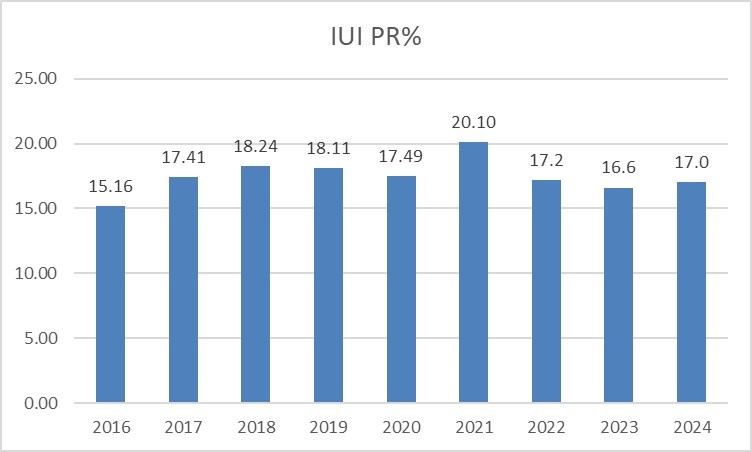
IUI success rates average around 15% per cycle, though this varies a fair amount from patient to patient. Sunflower's intrauterine insemination cycles usually lead to a pregnancy rate of between 20 to 30%; notably, during one of its cycles, in November of 2020, the pregnancy rate rose as high as 40 percent.

There are a number of factors that determine how successful IUI will be for a given patient. Some of those factors are the woman's age, the type of ovarian stimulation which has been used if any, how long the infertility has persisted, what is the cause of infertility, and how many good-quality motile sperm are there. Thus, it can be said that one number cannot be used for everybody and it is better to consult your doctor who will give you a clearer idea of your own situation.

Success Rate of IUI

How Many IUI Cycles Should You Try?

Success rates per cycle tend to drop off after about three attempts, and drop more noticeably after four or five unsuccessful cycles. Because of this, IUI is generally recommended for a maximum of three to four cycles before reconsidering the approach, often moving toward IVF if IUI hasn't worked by that point.

Risks and Complications

IUI carries a low risk of complications overall. There's a small risk of ovarian hyperstimulation linked to ovulation induction medications, though proper technique and close monitoring during the cycle help keep this in check. Multiple pregnancies are also a possibility when ovulation induction is combined with IUI. Less commonly, complications can include infection or uterine cramping.

Choosing an IUI Specialist or Centre in Ahmedabad

Many couples searching for the best IUI centre in Ahmedabad, or trying to shortlist the best IUI specialist in Ahmedabad, should really ask a more practical question like what should I actually look for? A few things matter more than any ranking or review score. How closely the centre monitors your cycle, since regular ultrasound tracking, as described above, is what makes a real difference to outcomes. How much experience the specialist has, across both straightforward cases and more complicated ones. Whether they take the time to explain your individual chances honestly, rather than a general number. And whether they're clear and upfront about when it may be time to move from IUI to IVF, rather than continuing cycles that are unlikely to succeed.

At Sunflower, IUI cycles are monitored through transvaginal ultrasound at the intervals described earlier. Our reported pregnancy rates have generally been in the 20 to 30% range, with one month, November 2020, reaching 40%. These same four questions, on monitoring, experience, honesty, and knowing when to move on, are worth asking before starting treatment anywhere, whether you're evaluating us or comparing the best IUI hospitals in Ahmedabad or best IUI centres in Ahmedabad.


Frequently Asked Questions

What exactly happens during IUI?

A semen sample is processed in the lab to concentrate the healthiest, most motile sperm, and that sample is placed directly into the uterus using a thin catheter, timed around ovulation.

Is IUI painful?

Not typically. Most patients describe it as similar to a Pap smear, a brief moment of discomfort at most. No anaesthesia is needed.

How is IUI different from IVF?

IUI means putting sperm into the uterus with the fertile process taking its course. On the other hand, IVF means taking ova, fertilizing them in vitro, and placing the fertilized ovum back into the womb. Surely, IUI is a less complex and cheaper option, but it is not appropriate for every infertility case, especially when the problem lies in severe male factor or blockage of tubes.

Can IUI work if my partner has a low sperm count?

It depends how low. If the total motile sperm count after processing is above 5 million, IUI can still be worth trying. Below that, and especially under 1 to 5 million, success rates drop sharply, and IVF with ICSI usually becomes the more realistic option.

How do I find a leading IUI specialist in Ahmedabad for my situation?

Look for the center that monitors your cycle, how much experience does center and doctor hold. Because some cases need extra care and monitoring. Also check if they are honest about your chances rather than just giving the same treatment as 50 other patients. Those points make the best IUI center different from others.

How many IUI cycles should we try before considering IVF?

Most specialists recommend three to four cycles, since the chance of success per cycle declines noticeably after that. If IUI hasn't worked within that range, it's generally a reasonable time to discuss IVF.

If you're weighing IUI against other options, or comparing IUI specialists in Ahmedabad, our team can walk you through your own test results and history so you know exactly where you stand.

Talk to a Fertility Specialist