


Interventional Sonography
Certain treatments require more than just a diagnostic scan, as they need a needle to be placed correctly in real time while the physician is able to see what he is doing. This is what interventional sonography does: uses ultrasound not only for diagnosis but for treatment as well. At Sunflower, it covers five specific procedures, ovum retrieval, ovarian cyst aspiration, CVS, amniocentesis, and multi-fetal pregnancy reduction, each one done under direct ultrasound visualisation.
Among these, ovum retrieval and cyst aspiration are processes used in the treatment of infertility whereas CVS, amniocentesis and multi-fetal pregnancy reduction are processes related to interventional sonography in obstetrics, used during pregnancy.
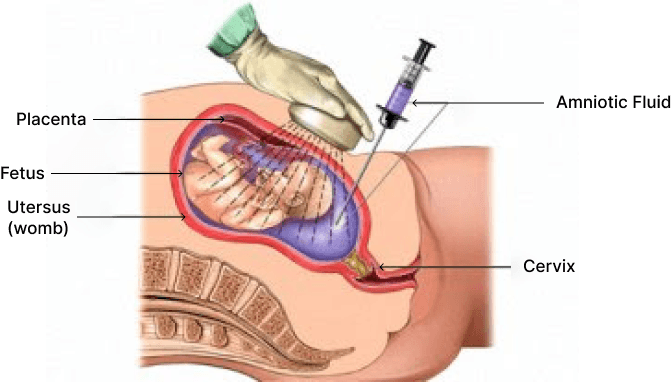
What is Interventional Sonography?
A regular scan just shows you what's there. With an interventional technique, the same kind of imaging goes on live while a needle is actually penetrating the tissue, so that the physician can clearly see where it is in relation to the ovary, the placenta, or the sac of amniotic fluid, and make real-time adjustments. Thus, real-time imaging is what makes it possible to perform egg retrievals and amniotic fluid extractions without open surgery.
Ovum Retrieval
This is the step in an IVF cycle where eggs are collected from the ovaries after stimulation. It takes place in the operation theatres of IVF under full anaesthesia, just like any surgical process where proper aseptic measures are taken. A needle guide that has been cleaned is attached to the ultrasound probe, the sterilised lubricant is also applied, and the process begins by slowly placing the probe in such a manner that the specialist can see all follicles clearly and lead the needle straight to them to take out the eggs.
Ovarian Cyst Aspiration
Not every ovarian cyst needs surgery. If a cyst is benign, the kind that shows up dark, or anechoic, on ultrasound, meaning it's filled with clear fluid, it can often be treated with a simple aspiration that takes about two minutes. This usually works for recurrent functional or non-functional cysts under roughly 6-7 cm.
The transvaginal probe, fitted with a retractable needle attachment, is guided in, and the specialist advances the needle through the vaginal wall into the cyst, watching the whole way on ultrasound. The fluid is drained and sent off for testing. No anaesthesia needed, it's an outpatient procedure, in and out.
It is essential to know in advance that there is a 30% chance of recurrence and, if that happens, the procedure must be repeated. But even with the recurrence rate considered, aspiration of a cyst is much cheaper than laparoscopic surgery and allows patients to recover much faster.
CVS Also Known as Chorionic Villus Sampling
CVS can be done earlier than amniocentesis, usually around 10 to 12 weeks. A small sample of placental tissue is taken, either through the cervix with a sampling catheter or through the abdomen, both done under ultrasound guidance so the specialist can steer well clear of the fetus and placenta while collecting the sample.
Amniocentesis
Amniocentesis usually happens around 16-17 weeks. Some amount of amniotic fluid is extracted, which has fetal cells that can be cultured and karyotyped, as well as used for metabolic or genetic testing.
To begin with, a preliminary ultrasound is performed so that information is obtained regarding the gestational age of the fetus, number of fetuses present, position of placenta and any visible abnormalities that may be present in the fetus. Iodine antiseptic is used to clean the abdomen and local anaesthesia is given to skin and tissues. After that, the fluid pocket is confirmed again using ultrasound and a 22-gauge spinal needle is used to withdraw fluid after direct observation. The first bit of fluid drawn is discarded, just to avoid any contamination from maternal blood, and then 15-20 ml is collected for testing.
Multi-Fetal Pregnancy Reduction
When three or more fetuses are present, which happens more often with assisted reproduction than naturally, the pregnancy carries a meaningfully higher risk of complications for both the babies and the mother, including a higher chance of losing the pregnancy altogether compared to carrying one baby. This is where a specialist might raise multi-fetal pregnancy reduction as an option worth discussing.
It's usually done between nine and twelve weeks, around week eleven, since results tend to be best earlier on. The procedure happens under anaesthesia, in an operation theatre. Guided by ultrasound, a needle is passed through the abdomen or vagina, and potassium chloride is given to the selected fetus, usually whichever one is lying uppermost. Most often, the pregnancy is reduced down to two.
This isn't a decision anyone makes lightly, and it's not made in isolation either, it's worked through together with your specialist, based on your specific pregnancy.
When Your Doctor Might Recommend One of These Procedures
The reason for which you are being referred depends entirely on your unique situation. For instance, depending on whether you are going through an IVF cycle, or you have any reoccurring cyst, or if there is a family history necessitating genetic testing or there is a complicated pregnancy requiring regular monitoring. Your specialist will explain why a specific procedure is right before you and the need for it in your case without missing out alternatives that you may find helpful.
Frequently Asked Questions
What is interventional sonography?
It is the application of ultrasound imaging in guiding a procedure through a needle or instrument, i.e. performing an operation as opposed to solely diagnosing the condition. It is a technique that made ohm retrieval, cyst aspiration, CVS, and amniocentesis possible without having to go through surgery.
Is ovarian cyst aspiration a permanent solution?
Not always. In some cases, which account for 30%, the fluid builds up again, which requires the procedure to be redone; however, as it is cheaper and quicker in recovery terms than laparoscopic surgery.
What's the difference between CVS and amniocentesis?
CVS is done earlier, around 10-12 weeks, and tests placental tissue. Amniocentesis is done later, around 16-17 weeks, and tests amniotic fluid containing fetal cells. Both are used for prenatal genetic evaluation, and your specialist can advise which is appropriate for your situation.
Is amniocentesis painful?
Local anaesthetic is used before the needle is inserted, so discomfort is generally limited. The procedure itself is brief, and it's done under continuous ultrasound guidance for accuracy.
Why would multi-fetal pregnancy reduction be recommended?
It's considered when three or more fetuses are present, since higher-order multiple pregnancies carry a meaningfully higher risk of complications for both the mother and the babies. It's a decision made individually with your specialist, based on your specific pregnancy and circumstances.
If any of these procedures has been recommended to you, or you'd simply like to understand your options before your next step, our specialists are available to talk it through with you.
Talk to a Fertility Specialist